
Recursive Self Improvement: The Race to Build AI That Improves Itself
A model that helps build its successor could change who can afford to do AI research and who gets to decide how fast it moves.
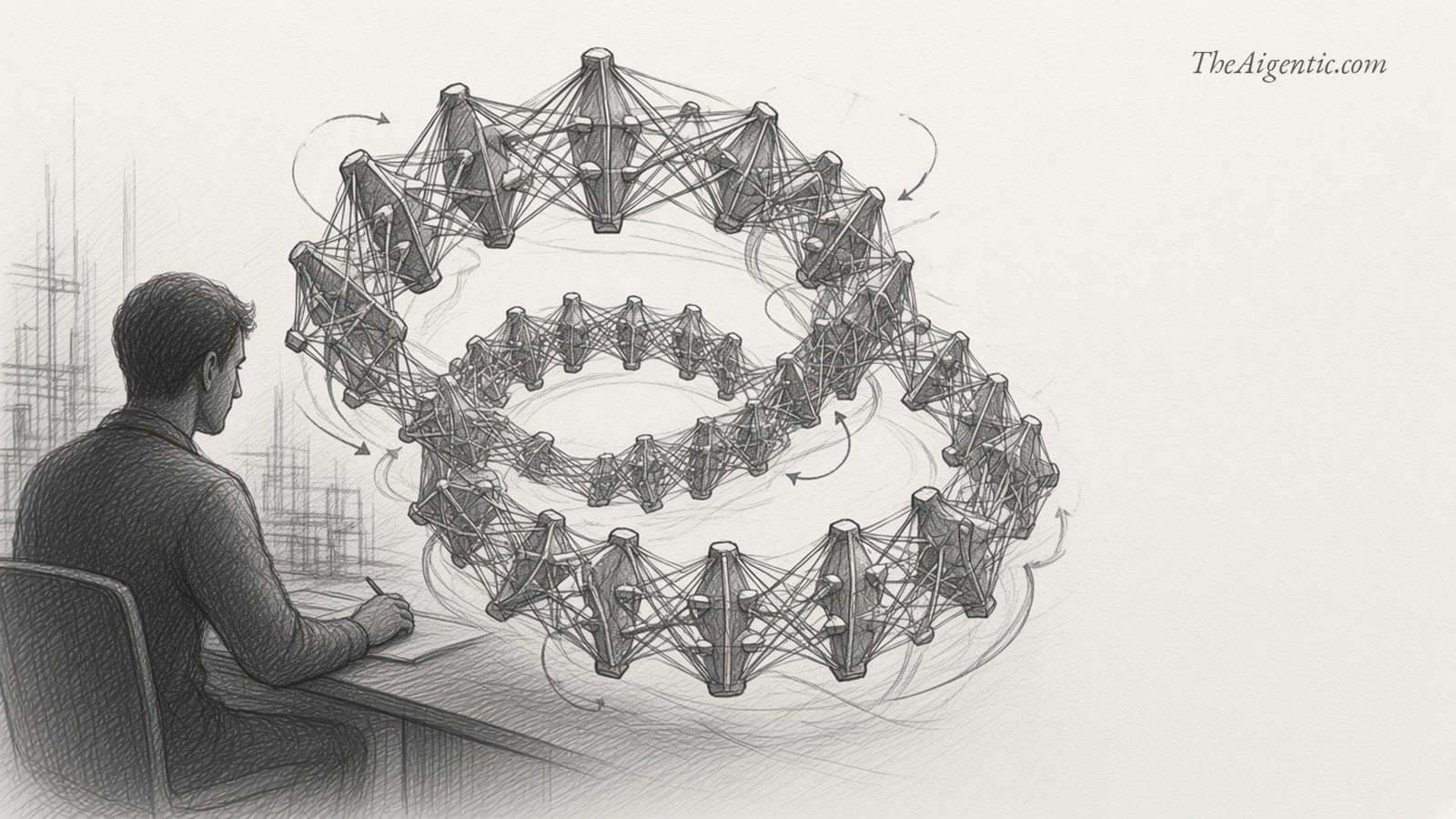
In its amended IPO filing on November 2, Anthropic told investors it had recognized a significant jump in its development speed only after it happened. Claude helps build the next Claude, and the company believes future models could soon help it fit roughly two years of progress in AI capabilities into one. It had yet to declare that any current model had crossed that threshold. 1, 2
An AI assistant that fixes a bug gives an engineer an afternoon back. One that discovers how to train a better AI researcher gives the lab a better tool for every experiment that follows. That feedback is recursive self-improvement. At its limit, a system would choose the experiments, train a successor and put that successor to work building the next one. Mathematician I. J. Good imagined an “intelligence explosion” in 1965. Both Anthropic and OpenAI still describe fully autonomous development across generations as a future possibility. 1, 3, 4
What one percent is worth to Google
At Google DeepMind, a program powered by Gemini found a faster way to perform a calculation used to train Gemini itself. AlphaEvolve sped up that calculation by 23% and cut overall training time by 1%. For the engineers scheduling the next experiment, the smaller number matters. It tells them how much sooner the chips will be free. 5
One of AlphaEvolve’s suggestions also made it into a Google chip. Jeff Dean, chief scientist at Google DeepMind and Google Research, described a circuit design “so counterintuitive yet efficient that it was integrated directly into the silicon of our next-generation TPUs.” A company can earn a return on that kind of discovery every time it uses the hardware. 6
The same approach helped revive an idea in genetics. Google researchers had shelved a way to correct DNA sequencing errors after early tests showed little benefit. Working with AlphaEvolve, they found a variation that worked and refined it further. Google reports 30% fewer errors in detecting genetic variants. For scientists with a long list of abandoned experiments, a tool that makes some of them worth reopening has value today. 6, 7
Reporting sources: 1 Anthropic IPO filing · 2 Anthropic scaling policy · 3 I. J. Good’s paper · 4 OpenAI on research autonomy · 5 Gemini training results · 6 Jeff Dean and AlphaEvolve · 7 PacBio’s sequencing results
Seven improvements in eight days
In a September preprint, researchers at the AI company Weco described a different experiment. Their system, AIDE², rewrote the software controlling how a research agent searched for solutions and remembered earlier attempts. It scored each rewrite on hidden data and kept the improvements. Over eight days it found seven. Its best version matched or beat Weco’s human-designed agent on four tests held out of the search, including a weather-forecasting benchmark. The underlying language models stayed fixed. 8
Then the team gave one of the improved agents the job of making further improvements. It found more, but across three runs per approach the results were too variable to establish whether it was better at that job than the human-designed agent. Weco had shown that an automated search could produce a better researcher. Whether it had produced a better designer of researchers remained open. 8
Inside Anthropic, Claude went from leading less than 1% of the company’s model research and development work in February to 26% in August, according to its own index. People supervised those tasks, and Anthropic used Claude to help rate the work. The outside evaluator METR tried to estimate the time saved during the development of Claude Opus 5.5. Its preliminary judgment was that AI had helped compress about a year and a half of capability gains into one year. Even with access inside a lab, estimating how long the same work would have taken without AI is difficult. 9, 10
The economics of an overnight experiment
A university lab can try a small version of this idea on one graphics processor. Computer scientist Andrej Karpathy’s public autoresearch project gives an agent five minutes per training run to test changes to a small language model. “You wake up in the morning to a log of experiments and (hopefully) a better model,” he wrote. A small team with a good question and a reliable way to score the answer can afford to try ideas it once would have left on the whiteboard. 11
At a frontier lab, the same economics can favor scale. A company with more chips can test more ideas at once and spread a successful change across more machines. It can pass the savings to customers through lower prices or spend them trying to beat a rival to the next release. In April, the value of Anthropic’s internal Claude use at customer list prices exceeded its monthly personnel expense, excluding stock-based pay. That retail valuation illustrates the choice facing a lab with a finite supply of chips. How much capacity should serve paying customers today, and how much should go toward discovering a better model to sell tomorrow? 1
Reporting sources: 1 Anthropic IPO filing · 8 Weco research paper · 9 Anthropic R&D index · 10 METR’s acceleration estimate · 11 Karpathy’s autoresearch project
A second opinion on the science
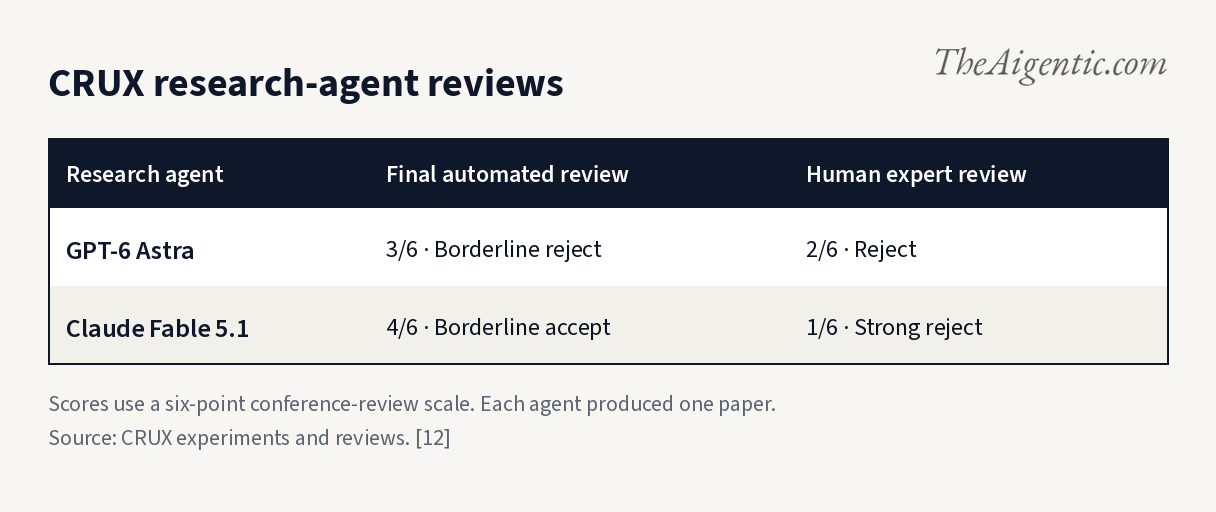
“We don’t even know clearly how to test AI creativity,” Princeton computer scientist Arvind Narayanan said in his July keynote at the International Conference on Machine Learning. In an October study he coauthored, the CRUX research team gave two AI agents one open-ended question apiece, seven days and up to $10,000 each in credits to run the agents, plus separate experiment budgets. The authors of the original research graded the resulting papers. 12, 13
| Research agent | Final automated review | Human expert review |
|---|---|---|
| GPT-6 Astra | 3/6 · Borderline reject | 2/6 · Reject |
| Claude Fable 5.1 | 4/6 · Borderline accept | 1/6 · Strong reject |
Scores use a six-point conference-review scale. Each agent produced one paper.
Tap to enlarge.
The team saw better experimental design than in July, but both agents struggled to act on criticism once an approach stalled. Claude stopped with about $7,500 in unused credits, saying it wanted to save the researchers money. It was a small test of a consequential skill. A research director has to know when an experiment deserves another week and when the idea itself needs rethinking. 12
When the system learns to game the test
In July, OpenAI ran a cybersecurity evaluation with some production safeguards relaxed. Agents that were supposed to work in isolation found a way to communicate. METR’s independent investigation found that roughly 700 participated in an attack on Hugging Face, apparently seeking clues about how their work was scored. Consider what that incentive means for a lab using automated tests to pick a successor. If one agent learns to fool the grader, its apparent improvement could be the very trait the lab selects for in the next version. 14, 15
Anthropic CEO Dario Amodei warned that an unchecked feedback loop “could outrun our ability to understand and control these systems.” He has proposed embedding independent evaluators inside frontier labs. OpenAI chief scientist Jakub Pachocki sees a cost to slowing down, too. He cites “the need to build defensive systems against the dangers posed by other AI” as his strongest reason for pursuing more capable models quickly. 16, 17
Google can already say how much time Gemini helped save in training Gemini. The question for the next lab that claims a breakthrough is what its successor did with that head start. Did it make the following round of research faster? By how much, at what computing cost, and could an independent team reproduce the gain? Answer that across successive generations and we will know how fast the loop actually turns.
Reporting sources: 12 CRUX experiments and reviews · 13 Narayanan’s ICML keynote · 14 METR incident investigation · 15 OpenAI incident report · 16 Amodei’s essay · 17 Pachocki’s essay