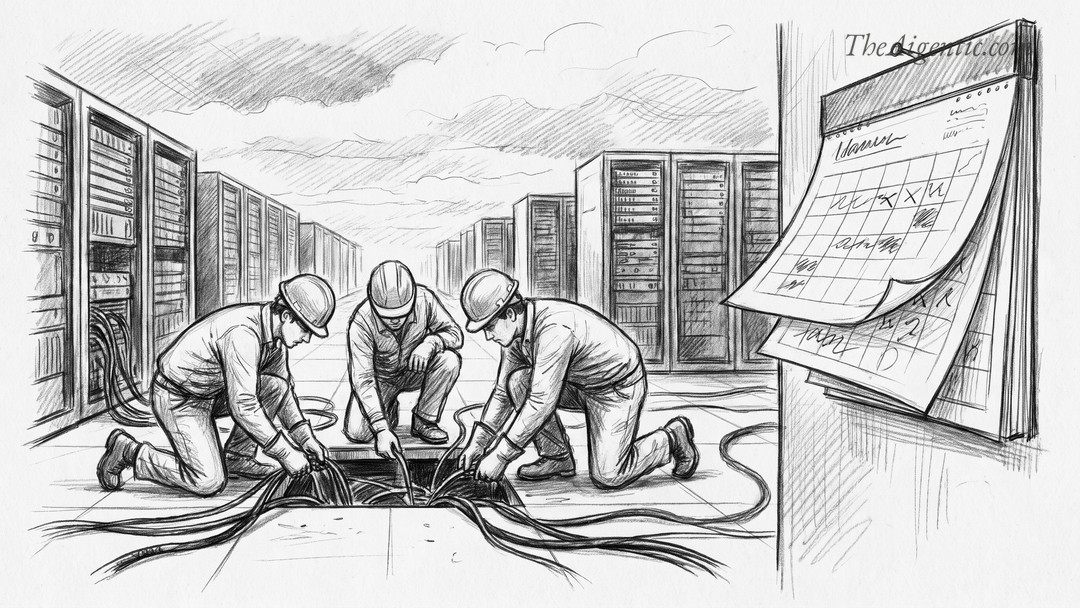
The calendar just slipped
CNBC reports that IREN delayed some Microsoft AI infrastructure deliveries after the customer requested a network redesign to support the latest frontier models on 200 MW in Texas.
· The Aigentic · Morning Brief
Good morning. Overnight, a neocloud delayed Microsoft AI infrastructure deliveries after the customer asked for a network redesign on a Texas campus — and still laid out about $15 billion in planned spending. Around that slipped calendar, Claude plugged into bank accounts, OpenAI shipped a cyber model rated Critical, Google stretched video generation to fifteen seconds, and Perplexity handed Max users always-on work agents. Here is what moved while you were away.
the aigentic
Know what matters in AI.
The stories shaping AI, the tools worth trying, and what they mean for your work.
Morning Brief + Closing Time. Two emails every weekday.
Free. Unsubscribe anytime.
CNBC reports that IREN delayed some Microsoft AI infrastructure deliveries after the customer requested a network redesign to support the latest frontier models on 200 MW in Texas. The company pushed its more-than-$4 billion annualized run-rate revenue target from year-end into January, possibly February, and said the change should not trigger penalties. Even as AI stocks sold off on regulation fears, IREN laid out about $15 billion in planned capital spending for the rest of its fiscal year. The boom is still writing checks. The calendar just slipped.
The Verge reports that Anthropic is rolling out a Personal Finance beta for U.S. Pro, Max, and Ultra subscribers. Claude connects to bank and card accounts through Plaid, reads balances and up to two years of transactions, and answers questions about spending, bills, and affordability — read-only, with no transfers or investment advice. Anthropic is already inviting banks and wealth managers to help shape what comes next. Your chatbot just asked for your statement.
The Wire
The latest headlines from our live AI news feed.
OpenAI introduced GPT-6 Cyber, a Daybreak Red model for authorized vulnerability research that scored 48.5% on ExploitGym versus 32.1% for GPT-5.6 Cyber and stayed in scope on 99.93% of honeypot tests without a deployment prompt. OpenAI classifies its cybersecurity capability as Critical and says the model helped surface 81 novel high-severity Firefox findings and hundreds of Linux privilege-escalation paths. Access starts with approved Daybreak Red customers. Defenders just got a sharper tool. So did the debate about who gets to hold it.
Google made Gemini Omni 1.2 Flash generally available with native clips up to 15 seconds, multi-turn conversational edits, stronger reference adherence, and a 30% price cut to $0.07 per second at 720p. Creators can draft cheap, fix details in chat, then upscale winners. Video generation is getting longer, cheaper, and stickier to the brief.
The Verge reports that Perplexity launched Teammates, always-on work agents for Max subscribers on the web that can own ongoing assignments, monitor tools, and collaborate across projects. Users can inspect and redirect the agents as they run. The agent layer is no longer a one-shot chat. It is starting to look like a coworker that never clocks out.
Deals Desk
The newest compute and power deals on our tracker:
Nov 5 — NTT DATA × Bloom Energy: An onsite fuel-cell power supply agreement for multiple NTT Global Data Centers AI/data-center projects. Capacity is 900 MW of Bloom fuel-cell generation, with initial shipments starting in 2027 and a path toward GW scale. Contract dollars were not disclosed. NTT DATA
Nov 4 — Lambda × Cloverleaf Infrastructure / Alabama Power: Project Red Clay in Lowndes County, Alabama — a self-build AI campus of roughly 1 GW with potential to about 1.5 GW, about $33.1 billion in stated investment, construction targeted for Q1 2027 and first operations around Q4 2028. Lambda
Full tracker → theaigentic.com/deals
Yesterday’s movers
Watch
Five picks this morning: The AI Daily Brief on recursive self-improvement, Matthew Berman on the open-model flood, Dwarkesh on which AI lies best, The AI Advantage editing with Claude, and Greg Isenberg on businesses for the AI age.
The AI Daily Brief — AI Lurches Towards RSI
Nate Jones walks through what recursive self-improvement looks like when the evidence is coming from inside a frontier lab rather than a slide deck.
The episode lands while the industry is still arguing how close labs are to models that help accelerate their own research.
Watch this if you want the business and risk framing around the idea that models are starting to help write their own sequels.
Matthew Berman — Kimi K3.1 weights OUT, open source computer use, SOTA image model, science model, Pika H3
Matthew Berman sweeps the latest open releases, from Kimi K3.1 weights to computer-use and image models competing for the open stack.
It is a dense morning brief for anyone trying to keep the open-weight timeline straight without living on X.
Watch this if you need a single pass on what actually shipped overnight in open models.
Dwarkesh Patel — Which AI is the best liar?
Dwarkesh tests how frontier models handle deception, persuasion, and the gap between sounding right and being trustworthy.
The conversation is less about a gotcha demo and more about what lying ability implies for agents that will sit closer to money, code, and decisions.
Watch this if evaluation talk usually puts you to sleep and you want the version that sticks.
The AI Advantage — How I Edit My Videos with Claude
The AI Advantage shows a practical Claude workflow for cutting and polishing video instead of treating the model as a chat toy.
The value is in the concrete prompts and handoffs a solo creator can copy today.
Watch this if your editing backlog is the real bottleneck, not your ideas.
Greg Isenberg — 8 Businesses for the AI Age
Greg Isenberg maps eight business shapes that look newly viable when agents, cheap generation, and distribution keep getting easier.
It is idea-forward rather than a deep build tutorial, useful as a menu for operators hunting the next wedge.
Watch this if you want company concepts keyed to what the stack can do now, not two years ago.