
Anthropic Releases Amended S-1: Explosive Growth—and a Harder Business to Value
Third-quarter revenue reached nearly $17 billion. The challenge for investors is deciding how much of that growth can become durable profit.

Anthropic’s latest IPO update strengthens the case that demand for artificial intelligence is becoming a substantial business. It also makes the investment debate more complicated.
According to Reuters’ reporting on the amended filing, Anthropic generated $16.96 billion in third-quarter revenue, up from $11.56 billion in the second quarter. Its quarterly net loss narrowed to $23.29 billion from approximately $66.3 billion. [1]
Those numbers invite two very different headlines: revenue is surging, and losses remain enormous. Neither, on its own, tells investors enough.
The more useful interpretation is that Anthropic is entering a new phase. Its commercial scale is increasingly clear. What remains uncertain is the relationship between growth, the cost of sustaining its models, and the price public investors will be asked to pay.
Our earlier coverage examined the original filing and whether Anthropic’s growth was already slowing, based on investor-presentation figures of about $16.8 billion. The amended filing now puts the quarter at $16.96 billion.
The growth slowdown is real—but needs context
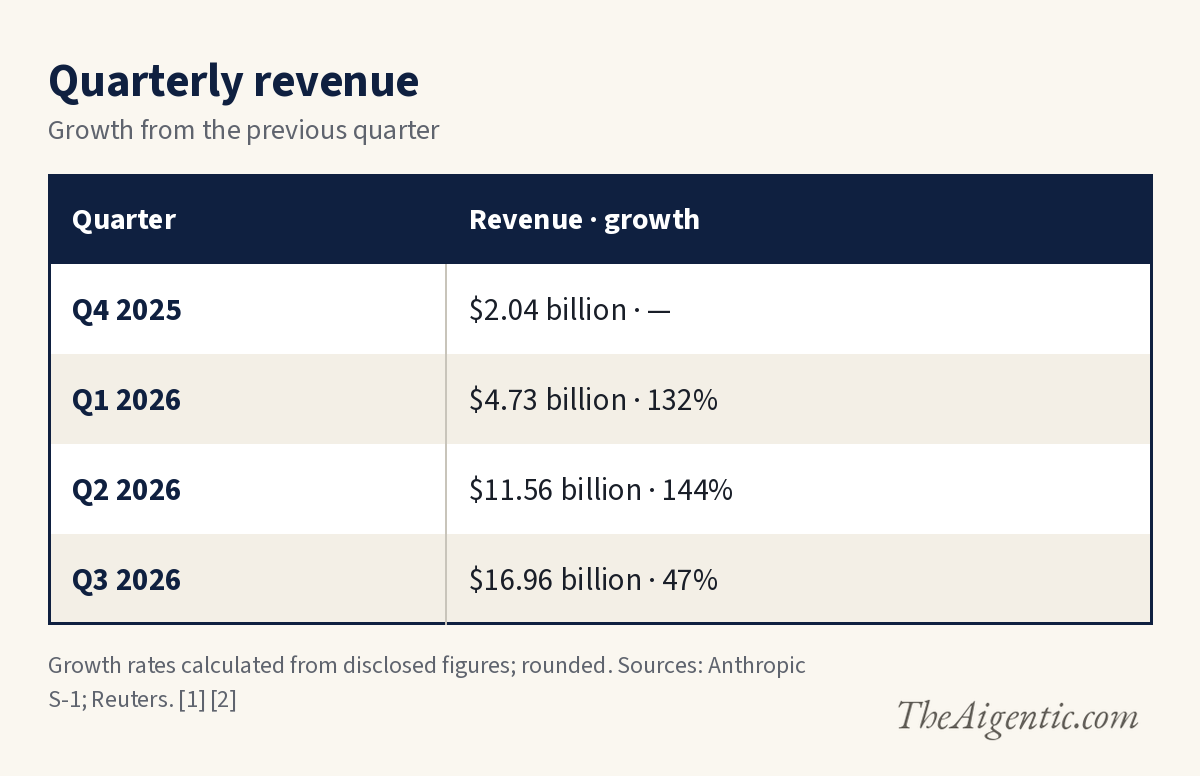
The original prospectus disclosed quarterly revenue of approximately $2.04 billion in the fourth quarter of 2025, $4.73 billion in the first quarter of 2026, and $11.56 billion in the second quarter. The newly reported third quarter extends that trajectory. [2]
| Quarter | Revenue | Growth from previous quarter |
|---|---|---|
| Q4 2025 | $2.04 billion | — |
| Q1 2026 | $4.73 billion | 132% |
| Q2 2026 | $11.56 billion | 144% |
| Q3 2026 | $16.96 billion | 47% |
Growth rates calculated from disclosed figures; rounded.
Tap to enlarge.
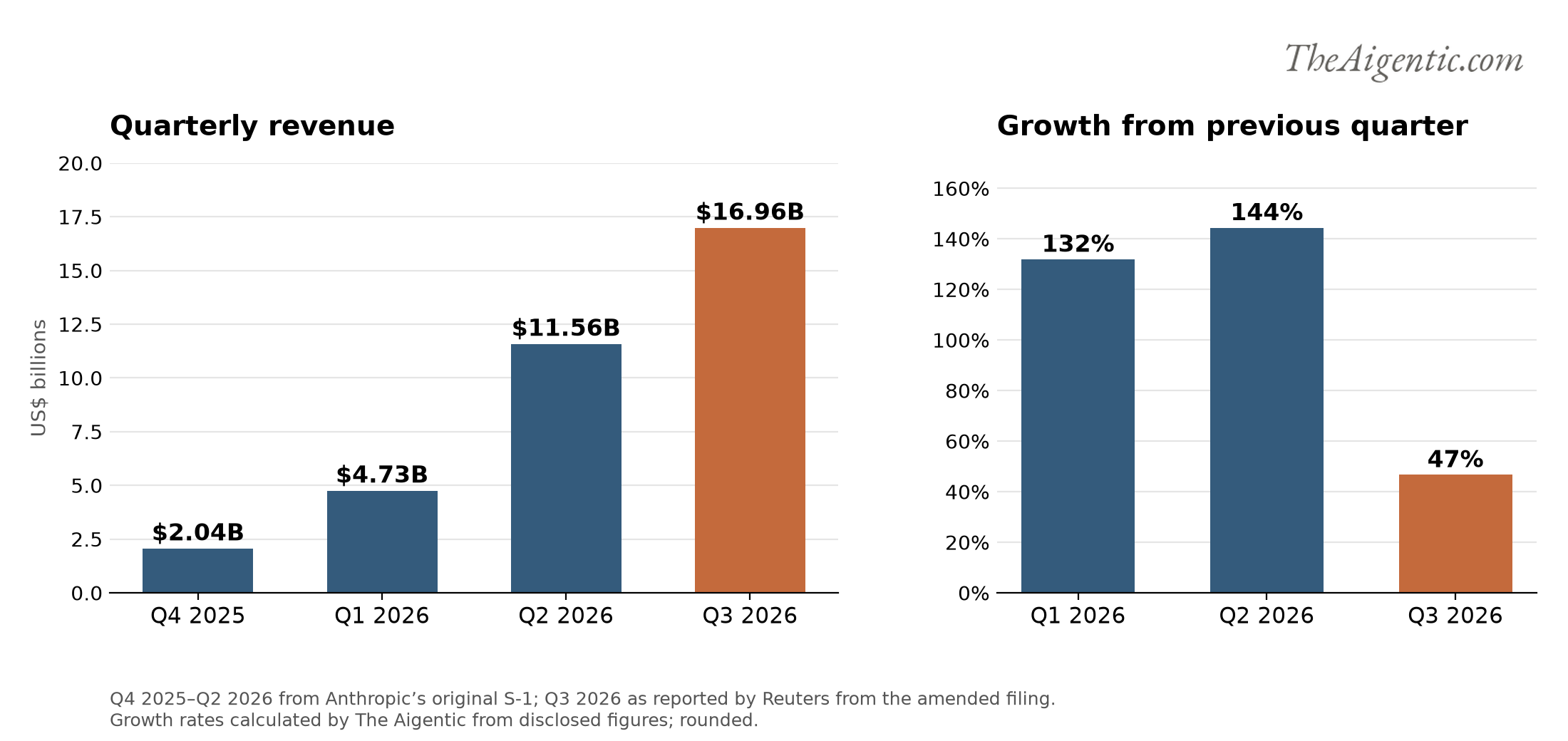
The percentage slowdown is substantial. A business that had been more than doubling its quarterly revenue grew by less than half in the latest period.
But the dollar comparison adds perspective. Anthropic added approximately $5.4 billion in quarterly revenue between Q2 and Q3, compared with roughly $6.8 billion between Q1 and Q2.
The latest quarter therefore shows both a sharp slowdown in percentage growth and a smaller absolute revenue increase. It does not establish that demand is collapsing. It does establish that extrapolating the earlier growth rate would have been a mistake.
For IPO investors, that distinction matters. A company can remain extraordinarily successful while growing more slowly than the expectations embedded in its valuation.
The loss headline requires an accounting bridge
Anthropic’s original filing showed that Q2 included approximately $59.6 billion in fair-value charges associated with convertible notes, derivative liabilities, and financing instruments known as SAFEs. Despite its enormous net loss, the company reported $974 million in operating income that quarter. [2]
This is why the narrowing net loss requires careful interpretation.
A fair-value charge can reflect changes in the value of financing obligations rather than cash spent running the business during the quarter. The charge still matters to shareholders, but it answers a different question from operating profitability or cash consumption.
The latest headline figures alone do not establish how much the underlying business improved. That requires a reconciliation showing operating expenses, financing adjustments, taxes, and other items.
Investors should examine three measures together:
- Operating income: What remains after the expenses of running the business.
- Operating cash flow: How much cash operations generate or consume, including working-capital effects.
- Investment and contractual obligations: What the company must spend to support future operations.
A smaller net loss is encouraging only to the extent that its causes are understood. It cannot substitute for that analysis.
The central risk is a mismatch in financial flexibility
The original prospectus warns that revenue is primarily consumption-based, while compute commitments generally run over multiple years. Some arrangements require payment regardless of actual utilization. [2]
That creates an important asymmetry.
Customers can reduce usage, optimize workloads, or move tasks to another provider. Anthropic may have less flexibility to reduce its infrastructure bill at the same speed.
When demand rises quickly, committed capacity can become an advantage: the company has resources available to serve customers. When demand falls short, the same arrangement can pressure margins and cash flow.
This makes capacity planning central to the investment case. Investors need to understand when obligations become payable, how much capacity is already generating revenue, and what happens if expected demand arrives late.
Long-term commitments should not all be treated as an immediate bill. They also should not disappear from the analysis simply because they sit outside the current quarter’s expenses.
Cheaper AI could expand the market and pressure its suppliers
A falling price for intelligence can benefit Anthropic’s customers while creating a more difficult equation for Anthropic itself.
Lower prices can encourage businesses to automate more work. A task that was previously too expensive to run repeatedly may become economical. That can increase usage.
But more usage does not automatically mean better economics for the provider.
The outcome depends on whether volume growth and efficiency gains compensate for lower prices. Anthropic could process substantially more work while collecting less revenue per task. Alternatively, lower serving costs could allow it to reduce prices, expand demand, and preserve attractive margins.
The quarterly revenue total cannot distinguish those outcomes.
The most informative future disclosures would connect usage, realized pricing, and serving costs. Investors need to know whether customers are spending more because they are doing more valuable work, because workloads require more computation, or because pricing has changed.
Those are different paths to the same revenue figure—and they can produce different profits.
A $68 billion annualized pace is a reference point
Multiplying third-quarter revenue by four produces approximately $67.8 billion.
That is a useful way to describe the scale of the latest quarter. It is not a forecast, contracted revenue, or full-year recurring revenue.
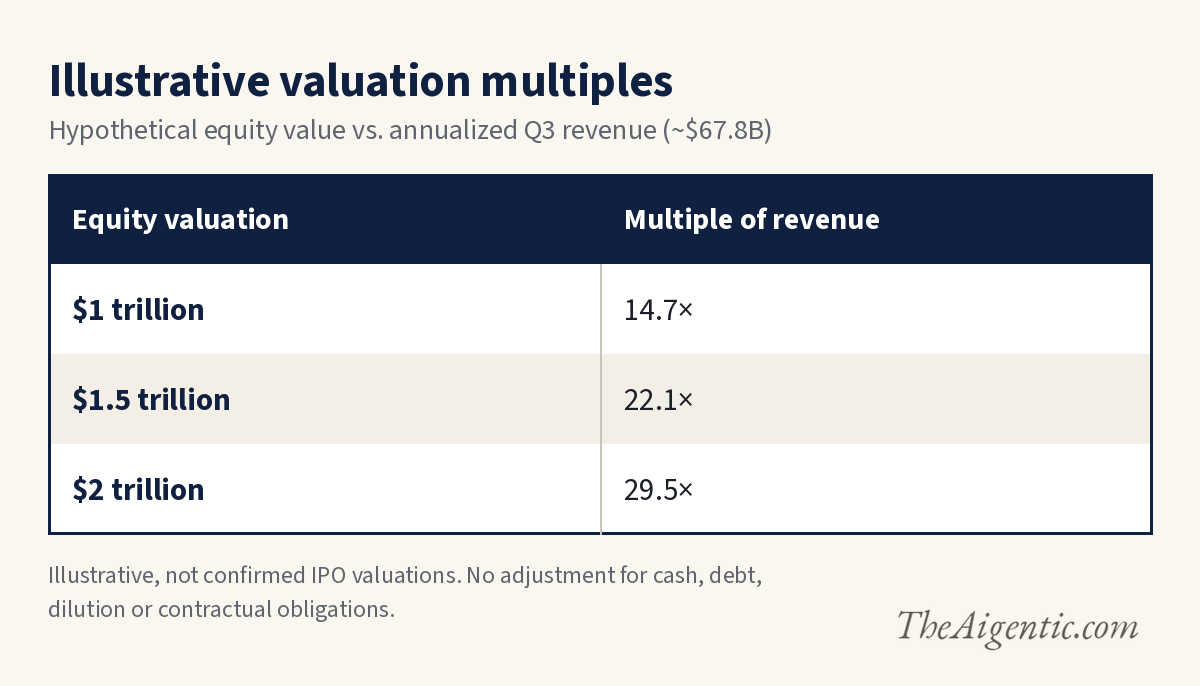
An illustrative valuation comparison shows why that distinction matters:
| Hypothetical equity valuation | Multiple of annualized Q3 revenue |
|---|---|
| $1 trillion | 14.7× |
| $1.5 trillion | 22.1× |
| $2 trillion | 29.5× |
Illustrative calculations, not confirmed IPO valuations. These are equity-value-to-revenue ratios and do not adjust for cash, debt, dilution, or contractual obligations.
Tap to enlarge.
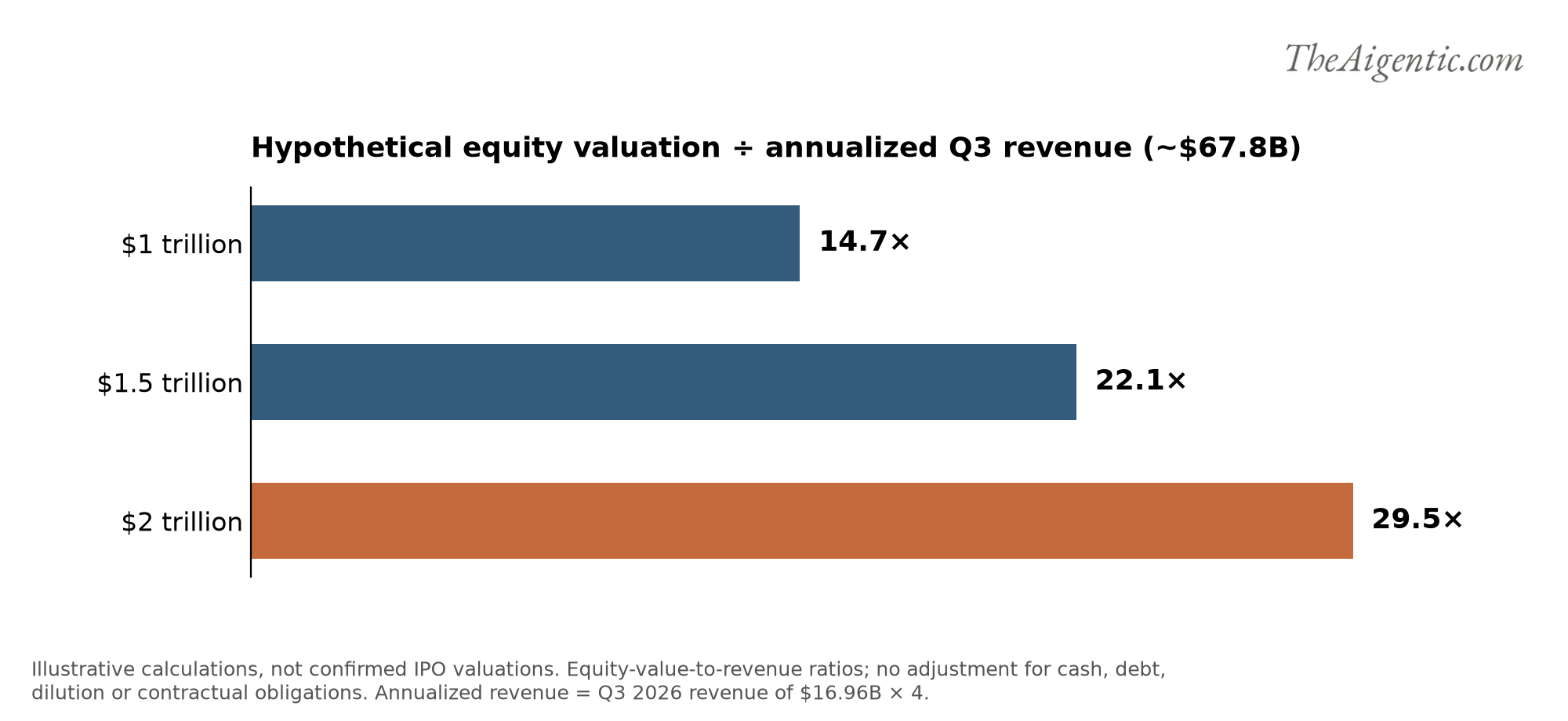
At higher multiples, investors are paying for years of future expansion. Strong current growth helps support that expectation, but the sustainability of margins becomes increasingly important.
Even excellent execution can produce a disappointing investment if the starting price assumes more growth or profitability than the company ultimately delivers.
What would strengthen the case
The most persuasive next disclosure would connect revenue growth to improving operating economics.
That would include sustained operating profitability, cash generation that survives changes in customer payment timing, and evidence that new infrastructure is being used productively.
Conversely, the concern would deepen if growth continued slowing while expenses and unavoidable payments rose faster than revenue. Heavy reliance on adjusted earnings would also deserve scrutiny if excluded costs remained economically significant or recurring.
These are tests for future results, rather than conclusions established by the latest reported revenue and net-loss figures.
The investment question has become more demanding
Anthropic’s latest update supports a consequential conclusion: the company is generating substantial revenue at extraordinary speed.
It leaves a more demanding question unresolved. How much of that revenue can consistently become cash available to shareholders after paying for the models, infrastructure, people, and distribution needed to sustain the business?
The bullish case rests on expanding demand, improving efficiency, and enough product value to defend pricing. The bearish case rests on slowing growth colliding with competition and inflexible spending obligations.
The amended figures give investors a clearer view of commercial momentum. A durable investment case will require equally clear evidence about profitability—and an IPO price that leaves room for uncertainty.
Sources and calculation notes
New third-quarter figures are from Reuters’ November 2 reporting on the amended filing; historical quarterly figures and risk disclosures are from Anthropic’s original S-1. This analysis focuses on those figures and is not a complete review of every amendment. Growth rates, revenue increases, the annualized figure and valuation multiples are The Aigentic’s calculations; hypothetical valuations are not forecasts or confirmed IPO terms.
Reuters — Anthropic’s quarterly loss shrinks, revenue jumps ahead of blockbuster IPO, November 2, 2026. Syndicated by U.S. News; third-quarter revenue and net loss from the amended filing.
Anthropic, PBC — Form S-1, filed October 26, 2026. SEC registration statement, including quarterly results and risk factors.
Related coverage: Inside Anthropic’s IPO Filing (October 26) and Is Anthropic’s Growth Already Slowing? (October 29).