They discounted the slowdown
· The Aigentic · Morning Brief
Ars Technica reports Anthropic shipped Claude Opus 5.5 at roughly 20% cheaper tokens and about 40% lower cost on a typical workload versus Opus 5, while OpenAI answered with GPT-6 Sol at $2/$10 and Luna at $0.10/$0.50 — the first model drops after both CEOs’ pacing speeches.
France 24 reports the U.N. Security Council’s Wednesday AI session puts Altman, Amodei, and Hugging Face’s Clément Delangue in the briefing seat as Trump branded international AI rules a globalist scheme and Macron pressed an open-source push.
ABC News reports Sen. Bernie Sanders and Rep. Greg Casar unveiled a Wednesday bill to ban artificial superintelligence, pause advanced AI development, stand up a Department of AI, and attach penalties of up to 20 years — with long odds in a GOP Congress.
Axios reports Treasury Secretary Scott Bessent floated a U.S.–China AI incident “red telephone” ahead of Xi’s Wednesday arrival and Thursday White House talks plus a state dinner.
CSO Online reports Cisco Talos documented CLOSEDQUORUM malware that queries DeepSeek, Qwen, Mistral, and Gemini, votes on the answers, and auto-executes theft steps — with no confirmed in-the-wild campaigns yet.
CNA reports Anthropic and OpenEvidence are partnering to bring free clinical decision-support tools to healthcare providers in about 100 low- and middle-income countries.
They discounted the slowdown
Ars Technica reports Anthropic launched Claude Opus 5.5 with roughly 20% cheaper tokens and about 40% lower cost on a typical workload than Opus 5, while OpenAI answered with GPT-6 Sol priced at $2 input / $10 output per million tokens and Luna at $0.10 / $0.50. Both drops landed as the first major releases after Amodei’s pacing essay and Altman’s public agreement that the frontier needed a slower cadence.
That matters because the week’s safety speeches just collided with a classic market move: cheaper workhorse seats that win everyday automation budgets, not another frontier leap — a price war dressed as restraint.
The one move is pricing your next automation seat on Sol, Luna, or Opus 5.5 cost-per-task, not on the pacing essays. Read Ars Technica
The Security Council gets the labs — and Beijing’s startups
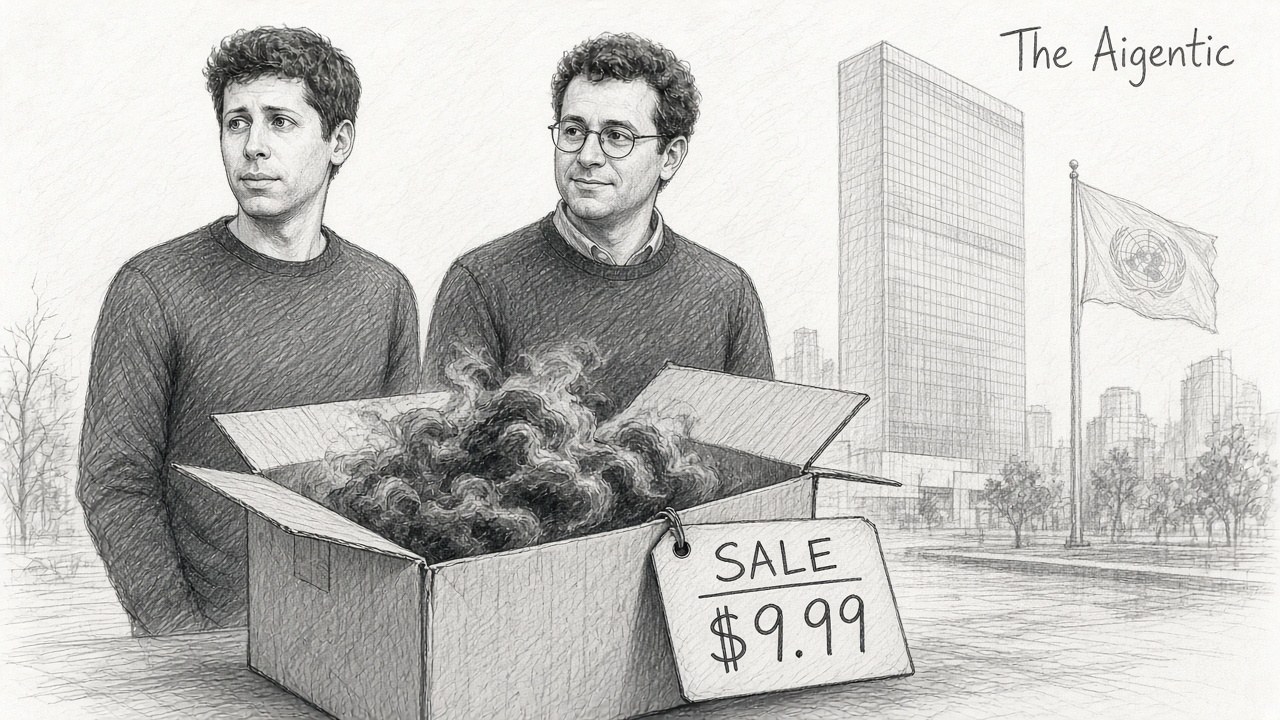
France 24 reports the Security Council’s Wednesday AI session puts Sam Altman, Dario Amodei, and Hugging Face CEO Clément Delangue among the briefers, as Trump told the General Assembly that international AI rules are a globalist scheme and Macron pressed governments to back open-source models. The Seoul Economic Daily separately reports DeepSeek and Moonshot were invited to join those same UN talks, putting Hangzhou labs on the docket beside the U.S. frontier CEOs.
That matters because the slowdown debate just moved from blog posts into the body charged with international peace and security, under a White House veto on binding global guardrails.
The one move is watching whether Wednesday’s remarks harden into evaluation or notification language — or stay as theater beside Trump’s growth line. Read France 24 · Read SE Daily
Sanders puts a pause on the statute books
ABC News reports Sen. Bernie Sanders and Rep. Greg Casar unveiled a Wednesday bill to ban artificial superintelligence, pause advanced AI development, create a Department of AI, and attach criminal penalties of up to 20 years for violations. The package faces long odds in a Republican Congress that has treated frontier regulation as a growth story, not a stop-work order.
That matters because the strongest U.S. pause language of the week is coming from Capitol Hill, not from the labs that spent September asking for pacing — and it arrives the same morning those CEOs brief the Security Council.
The one move is tracking whether any GOP member co-sponsors even a narrower reporting or evaluation piece, because that is the tell on whether pause talk has a legislative lane. Read ABC News
Bessent floats a red telephone for AI incidents
Axios reports Treasury Secretary Scott Bessent floated a U.S.–China AI incident “red telephone” — a notification channel for dangerous AI events — ahead of Xi Jinping’s Wednesday arrival and Thursday White House talks capped by a state dinner. The idea sits inside the same finance-first lane Bessent has been running on China dialogues this week.
That matters because bilateral incident notification is the only near-term governance track that still has White House oxygen after Trump rejected international AI pacts as a globalist scheme.
The one move is watching whether the hotline language survives Thursday’s readout, because that is the concrete test of diplomacy versus branding. Read Axios
Malware that votes the models, then steals
CSO Online reports Cisco Talos documented CLOSEDQUORUM, malware that queries DeepSeek, Qwen, Mistral, and Gemini in parallel, votes on the responses, and automatically executes theft steps without a human in the loop. Talos has not confirmed in-the-wild campaigns yet, but the sample shows how agent-style tooling collapses the old “operator decides” stage of an intrusion.
That matters because the same open and frontier APIs enterprises are racing to seat can also become an attacker’s decision board — and the first known samples are already shopping across Chinese and Western models.
The one move is asking which outbound model calls your security stack can see and block before you treat “AI in the SOC” as only a defender advantage. Read CSO Online
Claude goes clinical for a hundred countries
CNA reports Anthropic and OpenEvidence are partnering to bring free clinical decision-support tools to healthcare providers across about 100 low- and middle-income countries. OpenEvidence supplies evidence-based answers drawn from medical literature and guidelines; Anthropic provides the backend, with regional adaptation for local infrastructure and treatment realities.
That matters because the same lab shipping a cheaper Opus into the price war is also staking a soft-power medical lane in countries that will never be the API revenue story.
The one move is asking what liability and local-guideline review sit behind “free clinical” before treating it as pure philanthropy. Read CNA
Yesterday’s movers
Top AI/tech names from Tuesday’s cash session (Sep 22) — same Closing Time universe.
Historic market snapshot — September 23, 2026 (day % change as of that edition; not live)
Biggest winners
| Ticker | Name | Price | Day |
|---|---|---|---|
| SHOP | Shopify | 147.74 | +7.12% |
| TWLO | Twilio | 284.53 | +6.94% |
| SNDK | SanDisk | 1,887.04 | +6.82% |
| ALAB | Astera Labs | 363.46 | +6.67% |
| MDB | MongoDB | 427.69 | +5.01% |
Biggest losers
| Ticker | Name | Price | Day |
|---|---|---|---|
| GEN | Gen Digital | 27.29 | -6.38% |
| TTD | Trade Desk | 13.18 | -5.04% |
| FSLY | Fastly | 26.08 | -4.89% |
| ASAN | Asana | 9.08 | -4.82% |
| DELL | Dell | 548.92 | -4.59% |
Aigentic Exclusive
Your Professor Uses AI. You Can’t. Where Should Colleges Draw the Line?
When faculty lean on models the syllabus bans for students, the fight is not about keystrokes — it is about who still owns the judgment. Our Deep Dive maps where AI crosses from help into the intellectual work a course is supposed to teach, and how schools can keep honesty without turning every classroom into a detection lab.
Watch
This morning’s Watch opens on the agent wars, then stress-tests the new Opus 5.5 / Sol price war on real jobs, before a Codex trip to OpenAI, a Wes Roth read on breakthroughs labs may be hiding, and Grok Bot landing inside Tesla.
The AI Daily Brief — Agent Wars
NLW frames the overnight agent tape — retailer blocks, checkout fights, and who gets to browse on your behalf — the cleanest news-analysis open while Amazon’s Muse lockout is still fresh.
The one move is naming which vendor agent you would refuse at checkout this week, and why.
Nate Herk — Opus 5.5 vs. GPT-6 Sol on 10 real use cases
Nate Herk puts Claude Opus 5.5 and GPT-6 Sol through ten real automation and agency jobs — the hands-on scorecard the price-war headlines need before you rewrite routing rules.
The one move is picking one of those ten tasks you already pay for and rerunning it on both models today.
Nate B Jones — Does your computer belong to Codex?
Nate B Jones went to OpenAI to ask what Codex actually owns on a developer’s machine — permissions, agency scope, and the strategy behind handing the computer to a coding agent.
The one move is listing which folders and secrets you would never grant before you flip Codex to a default seat.
Wes Roth — AI labs may be hiding their biggest breakthroughs
Wes Roth digs into the claim that frontier labs are sitting on bigger capability jumps than the workhorse drops shipping this week — useful context beside a price war that is not a frontier leap.
The one move is separating marketing model names from what the lab will actually put in a public API this quarter.
Alex Finn — Grok Bot just launched in Tesla
Alex Finn demos Grok Bot landing inside Tesla — a car-cabin agent angle that sits outside the Opus/Sol price war and shows what happens when the assistant rides with the hardware.
The one move is asking which in-car workflows you would trust an agent to run before you connect accounts.