
NASA and IBM Use AI to Help Scientists Hunt for Lunar Ice
An open research model combines years of lunar observations to help researchers identify promising places to look.
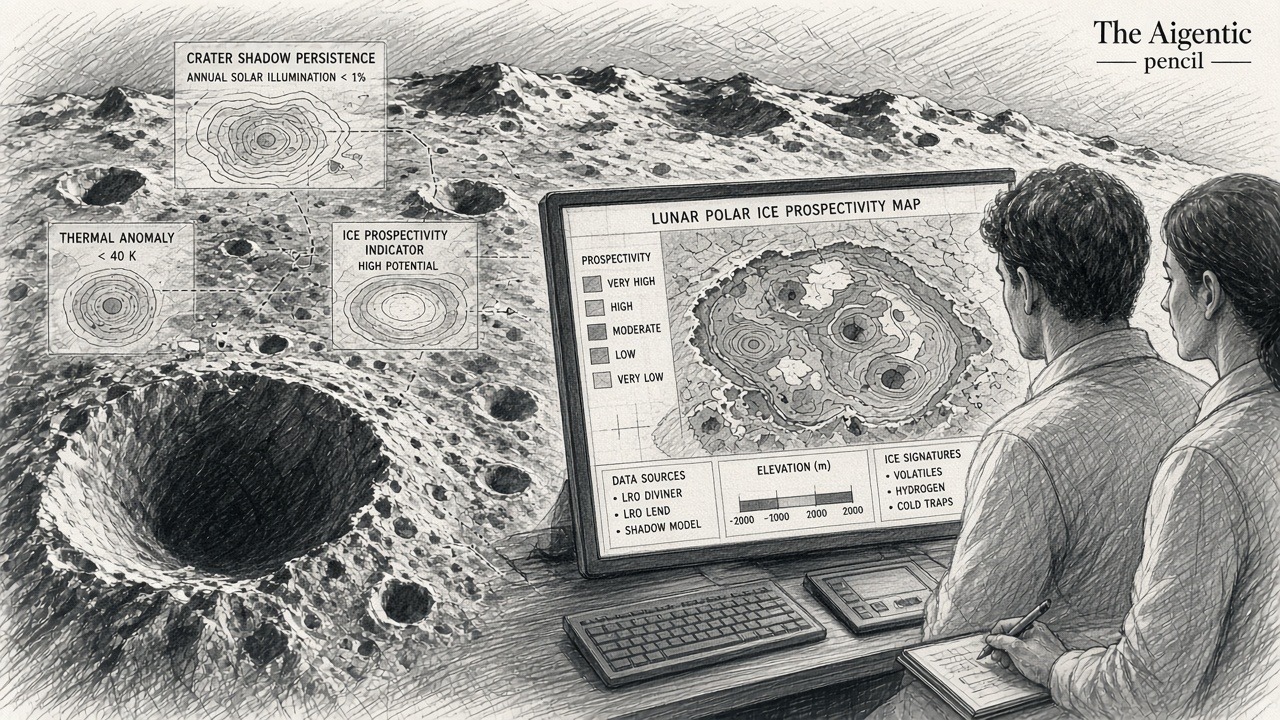
Lunar ice could change what a future Moon base needs shipped from Earth. Accessible deposits could supply water and, after processing, oxygen and ingredients for rocket fuel. Finding useful deposits starts with deciding where to look.
NASA and IBM released a new tool for that search on September 10: the NASA-IBM Lunar Foundation Model, an open-source AI system designed to help scientists analyze the Moon’s surface. Potential ice deposits are one target, alongside craters and volcanic features. IBM’s announcement.
The model draws on a substantial archive. NASA says its training included roughly two million image tiles, primarily from the Lunar Reconnaissance Orbiter, with additional observations from other missions. Scientists can adapt that training to a particular mapping task using smaller amounts of labeled data. NASA’s account of the project.
Near the poles, some areas remain permanently shadowed and cold enough to preserve ice. The practical challenge is combining observations that offer different clues about those places. An image, a terrain map, and a temperature measurement each describe part of the same landscape.
The new model learns relationships across those kinds of inputs. Researchers can use it to help estimate which locations have conditions associated with ice, then direct further investigation toward promising areas. NASA also describes applications for mapping impact craters and identifying unusual volcanic formations that could help explain the Moon’s geological history. Lunar science applications.
On one benchmark involving potential ice locations, IBM reports up to 22 percent lower prediction error than the comparison model SwinV2-B. That is a result for a particular test; performance varies by task. Benchmark details in IBM’s release.
The distinction between a useful prediction and a discovery matters here. The researchers’ model card says its ice outputs are evaluated against a prospectivity map, which estimates promising conditions, rather than measurements of ice itself. It also states that the model has not been validated to certify landing sites or clear hazards. Model documentation and limitations.
The open release gives other researchers a way to test those limits. The model weights, technical report, and links to code are publicly available, with the model repository listing an Apache 2.0 license. Teams can inspect the methods, compare results, and adapt the model to their own lunar research. Explore the model.
For us, the appeal is the chance to get more useful work from observations already collected at considerable effort. A map that helps a scientist choose the next area to investigate is a tangible contribution. Establishing what is actually there remains the next job.