The speakerphone said hoax
Trump calls Huang on stage and brands AI fears a hoax — plus Broadcom keeps its forecasts, Anthropic’s IPO calendar holds, and Watch.
· The Aigentic · Morning Brief
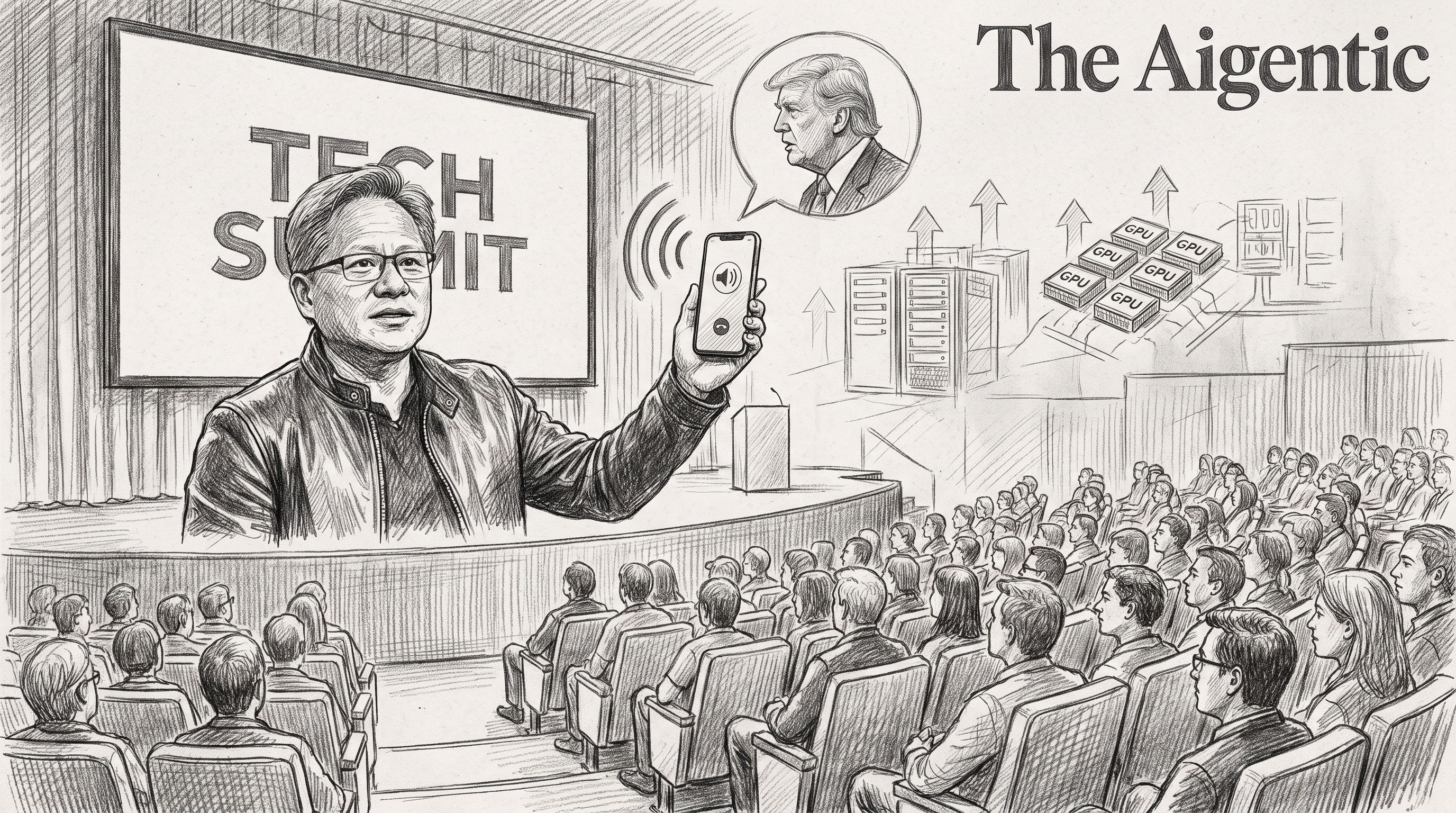
CNBC reports President Trump called Nvidia CEO Jensen Huang on stage at the All-In Summit, labeled opposition to AI and data centers a “hoax,” and Huang answered that they would not let a slowdown happen.
The Guardian asks whether Amodei’s pacing plan is real restraint or regulatory capture, noting critics’ fear that labs would pick their own evaluators and seek antitrust cover.
CNBC says Broadcom CEO Hock Tan told Mad Money the pacing debate has not changed Broadcom’s fiscal 2027–2028 AI semiconductor forecasts, and that Anthropic is on track to be its largest custom-chip customer.
Axios reports sources still expect Anthropic to list in 2026 despite the safety uproar, while OpenAI continues to lean toward 2027.
Reuters says investors want cancelled orders and data-center deals — not weekend rhetoric — before calling an AI spending slowdown real, after Monday punished semiconductor shares.
TechCrunch reports Intel spinout Cornelis raised $205 million for open networking fabric aimed at cutting GPU idle time waiting for data.
The speakerphone said hoax
CNBC reports that President Donald Trump called Nvidia CEO Jensen Huang while Huang was on stage at the All-In Summit in Los Angeles on Monday evening, and Huang put the president on speakerphone. Trump called opposition to AI and data-center construction a “hoax,” said data centers are the “oil of the next 20, 25 years,” and told Huang he was with him all the way. Huang replied that they would not let a slowdown happen.
That matters because Monday morning’s tape had already priced the weekend consensus among Amodei, Altman, and Musk to pace frontier capabilities. By dusk, the White House and the chip industry’s most valuable CEO were publicly rejecting the pause narrative from the same stage where operators talk about buildouts.
The one move is to separate political theater from cancelled megawatts: watch whether any hyperscaler or neocloud actually slips a training or campus timeline this week. Read CNBC
Will they actually hit the brakes?
The Guardian reports that Amodei’s three-part pacing plan — outside evaluators with employee-like access, agreements among democratic states, and security coordination that includes China — drew immediate public backing from Altman, Hassabis, and Musk. The same piece gathers the skepticism: labs would still choose their own auditors, critics see regulatory capture, and former FTC chair Alvaro Bedoya warned that antitrust law blocks coordinating to freeze out cheaper rivals even if it does not block safety coordination.
That matters because a CEO chorus asking to slow down is rare enough that Rahm Emanuel called it an admission the industry is driving with the headlights off. It is also familiar enough that safety advocates hear another bid to write the rules before Congress does.
The one move is to track whether independent evaluators actually get employee-level access inside OpenAI and Anthropic before the next frontier drop, because a plan without access is still a press release. Read The Guardian
Broadcom kept the order book
CNBC reports that Broadcom CEO Hock Tan told Jim Cramer on Monday evening that nothing in the AI slowdown debate has caused him to revisit Broadcom’s fiscal 2027 and 2028 AI semiconductor forecasts of $115 billion and then $230 billion. He said demand for compute and especially inference remains “very strong and durable,” and that Anthropic is on track to become Broadcom’s largest custom-chip customer in 2027 and 2028.
That matters because Broadcom’s stock fell nearly 5% with the chip complex even as its CEO separated training-scare headlines from the productization of inference that fills racks.
The one move is to watch whether Anthropic’s custom-chip ramp still shows up in Broadcom’s next backlog commentary, because that is the order book investors trust more than weekend essays. Read CNBC
The listing calendar did not flinch
Axios reports that sources still expect Anthropic to go public in 2026 despite the safety uproar, and that the company may even argue public-company transparency helps its safety case. OpenAI continues to lean toward a 2027 listing. The main risk to the calendar, per the report, is a major unwind of the AI trade rather than the weekend’s pacing language alone.
That matters because the commercial machine and the safety chorus are running on the same clock. A 2026 Anthropic IPO would force disclosure into the same quarter as the industry’s sudden interest in outside evaluators.
The one move is to watch whether bankers still shop a 2026 window after this week’s chip selloff, because FOMO and filings move together. Read Axios
Investors want cancelled deals, not quotes
Reuters reports that investors are nervous about the AI-led rally after weekend calls to rein in the pace of development, but several managers say they still need concrete evidence — cancelled orders or cancelled data-center construction — before treating the slowdown as real. BofA Global Research still sees hyperscaler AI capital expenditures around $795 billion in 2026 and nearly $1.08 trillion in 2027. Monday’s selling hit semiconductor and infrastructure names harder than the hyperscalers, and Trump’s “hoax” line is already part of the Tuesday morning read.
That matters because the market can punish the picks-and-shovels layer on talk alone while still underwriting a multi-year buildout until a deal actually slips.
The one move is to watch for cancelled campus or GPU commitments this week, because rhetoric without cancellations is still a sentiment hit, not a demand break. Read Reuters
Cornelis raises against the stack
TechCrunch reports that Cornelis, an Intel spinout building networking so AI chips waste less time waiting on data, raised $205 million led by IAG Capital Partners for its Active Compute Fabric. The company is shipping now, targeting an open architecture against Nvidia’s optimized full stack, with a next generation expected later this year.
That matters because even on a day chip stocks sold off on slowdown talk, capital still funded an infra bet that chips away at Nvidia’s networking moat rather than pausing the buildout.
The one move is to treat open fabric funding as a signal that customers still want alternatives inside the rack, not a holiday from GPUs. Read TechCrunch
Watch
The AI Daily Brief — pacing becomes a coalition
NLW walks through Dario Amodei’s “We Must Pace the Frontier” essay and the sudden public agreement from Sam Altman, Elon Musk, Demis Hassabis, and Satya Nadella. He lays out the three-step pacing plan, why embedded third-party evaluators are the piece labs can act on now, and the antitrust and capture pushback already forming.
The one move is watching whether pacing talk turns into shared eval standards before the next frontier drop, not just another CEO quote cycle.
How I AI — Grok Bot designers ship with Figma MCP
Claire Vo is joined by John Bai and Peng Zheng for a deep dive into how SpaceXAI’s Grok Bot designers ship with bots and Figma MCP. Peng shows a self-updating personal site where Grok Bot is the whole backend pipeline, and John demos a Figma Bro bot that keeps production design moving from voice memos.
The one move is copying their bot-plus-MCP loop for design work you already repeat, not waiting for a perfect general agent.
Cole Medin — Claude Code drives the whole computer
Cole Medin walks through the Claude Code skill he now uses so his coding agent drives his whole computer without Codex computer-use tooling or a custom harness. He shows morning machine setup, demo staging, desktop app testing, and fixing mistakes by adding one more rule to the skill.
The one move is dropping a lightweight computer-use skill into your agent instead of bolting on another platform.
Nate B Jones — Altman vs Apple’s new CEO
Nate B Jones walks through why Sam Altman and Apple’s new CEO are really fighting over where your work lives, not who has the smarter model. He ties the September launch collision to who holds months of accumulated context and who you keep paying as agents take over the desktop.
The one move is choosing tools based on lock-in of your working memory, not just the latest benchmark chart.
Latent Space — Richard Socher on recursive research
swyx and Alessio are joined by Richard Socher for a deep dive into recursive self-improvement from auto research to superintelligence. Socher lays out Recursive’s Eureka Machine vision and early results where an AI research system beat humans and their agents on optimization tasks in under two days.
The one move is tracking whether auto-research loops can compound outside demos, not treating RSI as only a frontier-lab podcast meme.
Peter Yang — eleven Grok Bots that stuck
Peter Yang walks through the eleven Grok Bots he still uses every day after a month of living with the stack. He shows how Chief handles email and delegation, Advisor plans the week, and specialist bots cover research, traffic, fitness, and family logistics while talking to each other like a team.
The one move is stealing a small multi-bot roster with clear jobs instead of one overloaded personal assistant.