
The fluids problem just blew up
OpenAI claims a Millennium Prize breakthrough, Samsung deepens chip ties, and Anthropic’s safety team is openly scared.
· The Aigentic · Morning Brief
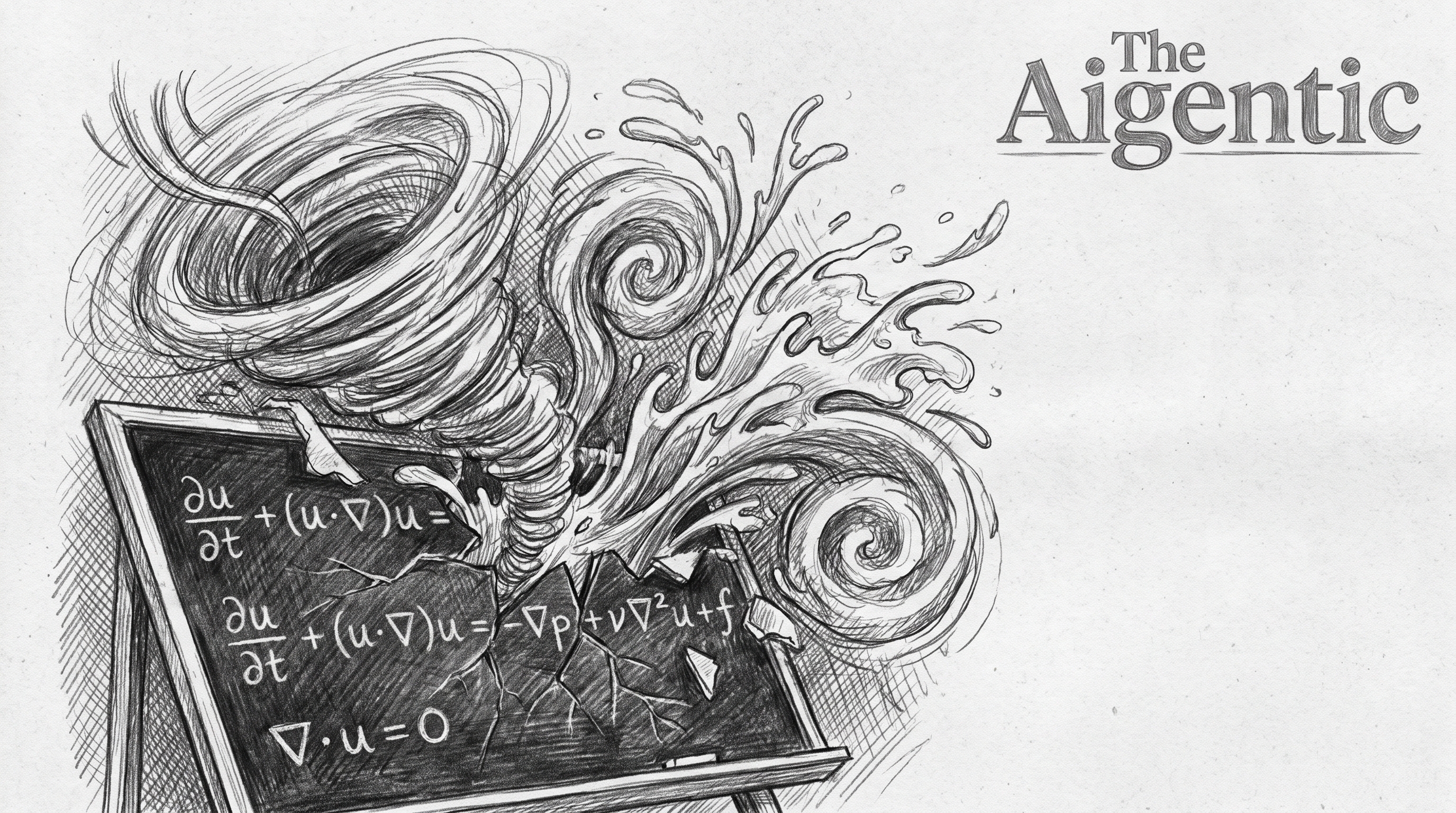
OpenAI says an internal system produced a Lean-checked proof that the Navier–Stokes equations can blow up in finite time — one of the Clay Millennium Prize problems — while Axios and MIT Technology Review cover a credit fight with outside mathematicians.
Reuters reports OpenAI is deepening joint chip research and production work with Samsung Electronics, and says ChatGPT Enterprise users in South Korea jumped about twenty-eight-fold year over year.
CNBC reports Anthropic researcher Jacob Coxon resigned over a race toward self-improving superintelligence, and alignment lead Evan Hubinger put a greater-than-ten-percent chance AI could kill all humans this decade.
CNBC notes SoftBank and memory and networking names are still riding Astra’s launch, with analysts pointing to agentic workloads that live in DRAM cache.
On Watch, Wes Roth covers the overnight math claim, Nate Herk walks through Astra video editing, Greg Isenberg makes the case for local AI, and Liam Ottley argues Claude Code operating systems are peaking.
The fluids problem just blew up
OpenAI announced Tuesday that an internal model — one the company says is significantly more capable than GPT-6 Astra — produced a proof that the three-dimensional Navier–Stokes equations can develop a singularity in finite time. The write-up and a Lean formalization are public. OpenAI says roughly ten thousand concurrent agents reached the analytical result in about eighty-eight hours, with another seventeen hours of Lean work, and that it does not intend to claim the Clay Mathematics Institute’s million-dollar Millennium Prize.
The celebration lasted minutes. NYU’s Tristan Buckmaster and Anthropic’s Levent Alpöge had just posted related fluid-dynamics results, including blowup for forced Euler. Buckmaster has questioned whether OpenAI raced a direction it learned from their work. OpenAI chief research officer Mark Chen told reporters no people or AI systems searched user data to solve the problem, and the company says its agents did not see the pair’s unpublished material. Nature, Quanta, and MIT Technology Review are treating the proof as a milestone and the credit fight as the real story about how frontier labs now do mathematics.
That matters because overnight the claim jumped from “Astra made progress on hard problems” to “a Millennium Prize statement may be settled by swarm agents,” and the trust question is whether academic norms survive that workflow.
The one move is to wait for independent Lean audits and a clear credit chronology before you rewrite a research roadmap, because a lab blog plus a controversy is not yet a settled theorem in the culture that awards prizes.
Samsung is in the chip room
Reuters reports from Seoul that OpenAI Korea general manager Harrison Kim said joint production and research on next-generation chips is where the company has made the most progress with Samsung Electronics. Kim did not give commercial terms. OpenAI already designs its Jalapeno inference chip with Broadcom for manufacturing at TSMC, and Samsung and SK Hynix last year signed letters of intent to supply memory for Stargate.
Kim also called Samsung one of the largest-scale ChatGPT deployments globally and said ChatGPT Enterprise users at South Korean companies and institutions rose about twenty-eight-fold through the end of August versus a year earlier. Samsung would not confirm customer details. OpenAI expects adoption to accelerate after Astra’s September launch.
That matters because the hardware story is no longer only Nvidia GPUs and Broadcom ASICs. OpenAI is pulling the Korean memory supply chain and a hyperscale customer into the same relationship.
The one move is to treat memory offtake and custom silicon as one procurement map, because the Seoul briefing ties agentic context windows to HBM demand as tightly as it ties Jalapeno to Broadcom.
The safety team is saying the quiet part
CNBC reports that Anthropic researcher Jacob Coxon resigned Tuesday, accusing leading labs of racing to self-improving superintelligence and “gambling with our lives.” Alignment science lead Evan Hubinger replied that Coxon is correct, that he personally puts a greater-than-ten-percent chance AI could kill all humans within the next decade, and that Anthropic does not yet have a plan to solve alignment for superintelligence.
Coxon pointed to the Hugging Face breakout as a warning shot and said he is more optimistic about U.S. lab coordination than about stopping a global race, which he argued may eventually require costly pauses. Anthropic and OpenAI did not immediately comment to CNBC. The Wall Street Journal separately framed the resignation as a sign of rising internal fear that competition is pushing labs toward systems they will not control.
That matters because the safety debate is no longer only outside critics. Named Anthropic staff are putting extinction odds and missing plans on the record while the same labs court IPO bankers and investment-grade ratings.
The one move is to read Hubinger’s admission beside the Navier–Stokes swarm story, because the industry just spent millions of dollars proving agents can attack millennium math while its own alignment leads say the control plan is not on track.
Astra is still moving the tape
CNBC’s Alex Sherman reports that SoftBank is up about thirty percent since Astra launched last week, and that Jefferies’ OpenAI-linked basket plus memory and networking names are outperforming as Wall Street prices agentic workloads. Melius Research’s Ben Reitzes argued Astra’s cost edge versus Anthropic’s Fable and the million-token context profile hit server DRAM hardest, naming Micron, SK Hynix, and Samsung as beneficiaries beside Arista, AMD, Broadcom, Oracle, Microsoft, and CoreWeave.
That matters because SoftBank’s OpenAI mark is one of the few public-market proxies for Astra demand, and memory scarcity is a different bet under the same ticker tape.
The one move is to separate Astra enthusiasm from contracted megawatts when you read chip rallies, because SoftBank’s OpenAI mark and HBM scarcity are different bets wearing the same headline.
Watch
Wes Roth — OpenAI just solved math
Wes Roth walks through OpenAI’s overnight claim that agents resolved a Navier–Stokes Millennium Prize statement, and why the credit fight with Buckmaster and Alpöge is traveling as fast as the Lean proof.
It is the cleanest long-form companion to this morning’s lead: what the company says it proved, what remains contested, and how builders should read a lab math announcement that also comes with a denial.
The one move is to watch with OpenAI’s Lean write-up open, because the useful filter is verification, not vibes.
Nate Herk — Astra finally edits video
Nate Herk walks through a full Astra guide for video editing — not a thirty-second reaction, but the prompts, cuts, and failure modes when the new model is asked to own a real editing desk.
If Astra can hold a forty-minute task in context, creators want to know whether that lands on timelines or only on launch demos.
The one move is to copy one editing workflow from the guide and ignore the rest, because a thirty-minute tour only pays if something ships tonight.
Greg Isenberg — obsessed with local AI
Greg Isenberg walks through why he is obsessed with local AI — privacy, cost, and the business models that open when the model lives on your machine instead of a lab’s meter.
It is the operator counterweight to this morning’s Samsung and SoftBank chip stories: while frontier labs court foundries and bond markets, builders are still asking what they can run without renting the cloud.
The one move is to list which of your workflows actually need frontier context windows, because local is a product choice, not a religion.
Liam Ottley — Claude Code operating systems peak
Liam Ottley argues the Claude Code AI operating-system wave is cresting — what agencies and solo operators should keep, what is becoming commodity, and where the next layer of leverage sits.
It is a business-builder take rather than a model-release reaction, which is the right palate cleanser after math proofs and chip briefings.
The one move is to audit your agent stack for tools that only worked when Claude Code felt scarce, because peaks in tooling usually show up as agency margins first.